What does primate morality say about us?
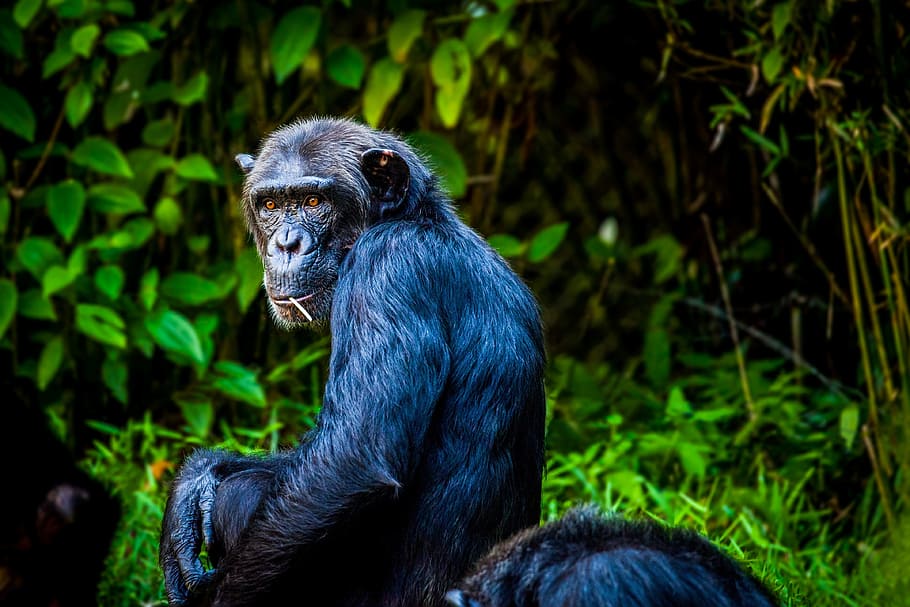
Throughout millennia, humans have always had the tendency to create conflicts, to destroy entire civilizations, and to disregard the ecosystems that sustain us; the tendency of our "biting the hand that feeds", so to say.
This is truly the enigma that has clouded humanity's existence.
The powerful magnetism of irrationality has plagued our primate kind for quite a damn long time in fact, and by long time, I really mean millions of years. Our capability of having the decision-making towards obviously horseshit decisions is what really separates us from other animals acting on instinct. But then again, instinct is a pretty (subjective) word.
Is a leader's desire to expand its territories by invading its neighbors for the sake of resources an act of instinct that is similar to how rats invade our homes to find food? Is our propensity for war an act of instinct that is similar to how male chimpanzees of one troop would wage war against male chimpanzees of another troop?
To review our violent tendencies, we have to look at how our ancestors are doing. And to do that, we have to begin uncovering the origins of morality, and whether our primitive ancestors had any grasps of moral understanding - or simply, the ability to know whether something is 'right" or "wrong".
Enter Frans de Waal, one of the world's premier primatologists, who believes that human morality has its beginnings in our early ancestors. Basically, he posits that non-human primates such as chimpanzees and macaques have a sense of understanding "right" from "wrong", such as in the sharing of resources. Moreover, he claims that these primates understand that certain actions have repercussions and can be punished for. They also show the ability to be able to mediate social conflicts.
In this case, Frans de Waal was also famous for demonstrating "reciprocity" in non-human primates. Essentially, reciprocity refers to the practice of exchanging things with others for mutual benefit (courtesy of uncle Google). In 2012, researchers found more compelling evidence to suggest that the human quality of empathy and altruism may not be so unique after all. In the study, twelve capuchin monkeys were paired up to conduct a simple experiment to explore direct reciprocity and prosociality; the pairs could choose between two options - A) the "prosocial" option being that it rewarded both individuals, or B) the "selfish" option being that it rewarded only one of the individual, and that is the chooser.
Each of the capuchin monkeys' choices paired with a familiar partner were compared against the choices of the capuchin monkeys paired with an unfamiliar partner. Very interestingly, the study reported that capuchin monkeys were "spontaneously prosocial" in that no matter who they were paired with - the other monkey gets their share of the prize.
This is perfect. The simple idea of reciprocity in non-human primates may be the very foundations of mutualism, social cooperation and social equity.
On the other hand, non-human primates have been shown to exhibit emotional behaviors when confronting a loss or death of a loved one. Jane Goodall, another giant of primatology, reported that following the death of his mother, young Flint - an 8 year old chimpanzee at the time - died just three weeks later. Possibly due to sorrow and grief. In another example, Charles Darwin (we all know who this guy is) reported in The Descent of Man - "So intense is the grief of female monkeys for the loss of their young, that it invariably caused the death of certain kinds".
What this goes to show is that non-human primates such as chimpanzees too have emotional faculties that are alike humans. Although they have been shown to commit infanticide in times of serious trouble, it will be the absolute last resort. These furry guys have a sense of being, as well as the understanding that others have a sense of being as well.
There is also the idea of reconciliation. Reconciliation is a key factor in sustaining relationships not only in non-human primates, but in humans as well. When looking at chimpanzees, they will almost always engage in friendly reunions after conflicts in an act of reconciliation. In fact, consolation by an uninvolved third-party is also commonplace after some deep shit between monkeys. This behavior, according to de Waal, is only present in great apes and humans, and yes - reconciliation is a type of affiliative behavior.
Experiments and anecdotes aside, almost all mammals have a limbic system thus most mammals do grasp the idea of emotions. However, non-human primates such as chimpanzees have not only a limbic system, but a brain that is asymmetrical. This key feature would suggest why chimpanzees show a preference for handedness (ie right vs left) which is also prevalent in human beings (not that it is important in this blog post however).
But there is a dark side to things; chimpanzees have shown to be extremely violent as well. They are literally capable of chimp-on-chimp bloodshed and massacre. They will even rip your face off as in the case of Travis the Chimpanzee.
For example, the chimp's Gombe War was literally Avengers: The Infinity War II-batshit type crazy. It was a battle of Alpha Males. There was Humphrey, the most high-ranking and dominant male in the troop, and two other chimps Charlie and Hugh, who were second-and third-ranking respectively. Humphrey was known for being rather aggressive - throwing rocks at the subordinates was daily fare. Humphrey could intimidate Charlie and Hugh when they were alone, but backed off when they were together - what a bully. To make matters worse, the area had a higher male to female ratio, which increases competition. High demand, low supply. As such, the only way to gain an upper hand is through increasing status aka being the baddest motherf*cker in the house.
Just like in humans, the Alpha Male and the less dominant subordinates created separate coalitions of sorts which resulted in inter-group attacks. This struggle for power costed the lives of 14 chimpanzees.
And because reproduction is so very important for these guys, there was really nothing they could do. The rudimentary idea of morality and adhering to it has been overwhelmed by the wanting of genes to be passed on. It was a perfect storm, so to say.
Primate morality is indeed a very real thing, however it also explains how with our own "advanced" morality we couldn't prevent wars and conflicts ourselves. While chimps kill often, we kill daily. While chimps wage wars that kill a dozen, we wage wars that kill a thousand (at least).


Comments
Post a Comment